
Conventional foreign trade risk control mainly relies on static datasets such as business registration and judicial records. Such approaches are limited in dynamically identifying issues including “registered enterprises with no actual production activities” and “paper trade”. Power data reflects tangible changes in production activity: whether power load aligns with declared customs volumes, and whether production schedules match order cycles. Cross-analysis of multi-source data enables supplementary assessment and verification against enterprises’ self-declared information.
Power data provides a new lens for credit evaluation. Credit assessment requires a comprehensive review combining corporate declarations, financial statements and business registration records alongside real operational performance. An official from the Enterprise Architecture and Digitalization Department of CSG Guangdong Power Grid Corporation noted that the integration of power data shifts risk assessment focus from “how an enterprise describes itself” toward “how an enterprise actually operates”. It furnishes objective reference for detecting operational shifts and mitigating information asymmetry.
From Raw Information to Credit Value: Unlocking Dividends of Data Elements
The inclusive growth of micro, small and medium-sized enterprises (MSMEs) is a key priority for APEC. Many MSME foreign‑trade enterprises face insufficient traditional credit records and high verification costs for operational status, creating barriers to securing credit lines, winning new orders and facilitating trade partnerships.
Power data translates continuous production and operational characteristics of enterprises into analyzable, verifiable reference information. It supports enterprises in demonstrating operational vitality, assists counterparties in due diligence, and aids financial institutions in credit underwriting. This advances data applications that serve real economic activities and extends the value of data elements to more MSMEs.
From Trusted Spaces to Market Applications: Establishing a Full Data Application Pipeline
The product also pioneers a complete application pipeline for data elements. Building on the National Data Administration’s pilot programme for the innovative development of trusted data spaces within the energy sector, China Southern Power Grid has built the Southern Energy Industry Trusted Data Space to underpin secure data circulation and integrated use.
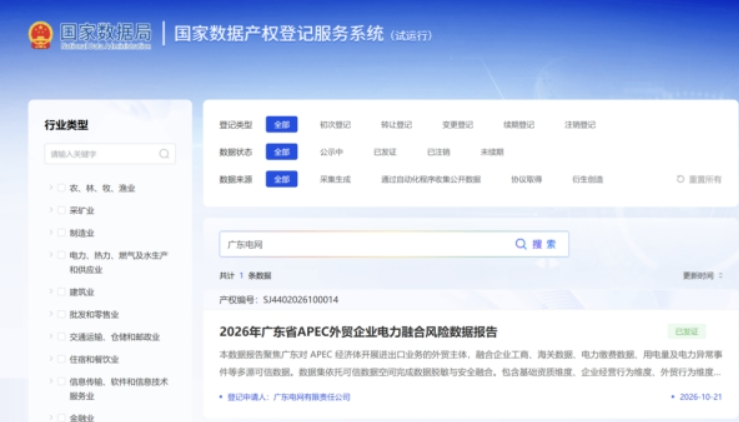
On this foundation, CSG Guangdong Power Grid Corporation — the first entity in China’s power industry and one of the nation’s first batch of certified data brokers accredited by the Guangdong Provincial Government Service and Data Administration Bureau — has accelerated the development and implementation of data products for real-world scenarios. The product went through public notification and certification via the National Data Property Rights Registration Service System, with registration and cross-region data circulation facilitated by the Shenzhen Data Exchange.
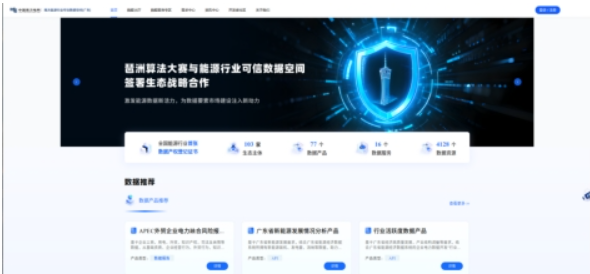
Southern Energy Industry Trusted Data Space (Guangdong Sub‑node)
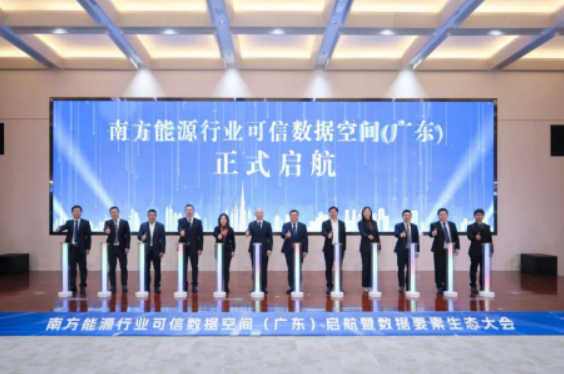
Southern Energy Industry Trusted Data Space (Guangdong Sub‑node) was officially launched in 2024.
Leveraging this pipeline, CSG Guangdong Power Grid Corporation is developing a suite of risk‑control data products targeting APEC‑related foreign‑trade enterprises and exploring the transformation pathway of “data resources → data products → data assets → data capital”. This initiative can serve as a reference for integrated data applications across gas, water, transportation and other sectors, accumulating practical experience in converting raw data resources into marketable data products and service offerings.
From Local Practice to Asia‑Pacific Reach: Reducing Regional Trust Costs
The solution strengthens supply chain resilience and addresses information asymmetry in trade. When trading partners cannot cost-effectively verify the sustained operation of counterparties, information gaps drive up cooperation costs and disrupt orders, credit terms and contract performance. By lawfully integrating power data, the product delivers a new reference for corporate risk evaluation, helping reduce information asymmetry and trust frictions in trade collaboration.
To explore pathways for data elements to empower the real economy, CSG Guangdong Power Grid Corporation has held exchanges and cooperation sessions with the Guangdong Cross‑Border Commodity Trade Association, helping its member enterprises access diversified risk intelligence. This initiative represents a tangible exploration to deploy data elements for the real economy within the existing regulatory framework.
As a pacesetter, forerunner and pilot zone in China’s reform and opening‑up, Guangdong is advancing market-oriented reform of data element allocation as its new focal point. This practice by CSG Guangdong Power Grid Corporation demonstrates the use of digital technology to bolster supply chain resilience and support regional trade risk assessment. It offers a replicable case for Asia-Pacific economies and broader international trade scenarios, contributing to deeper Asia-Pacific economic and trade cooperation and shared prosperity.
